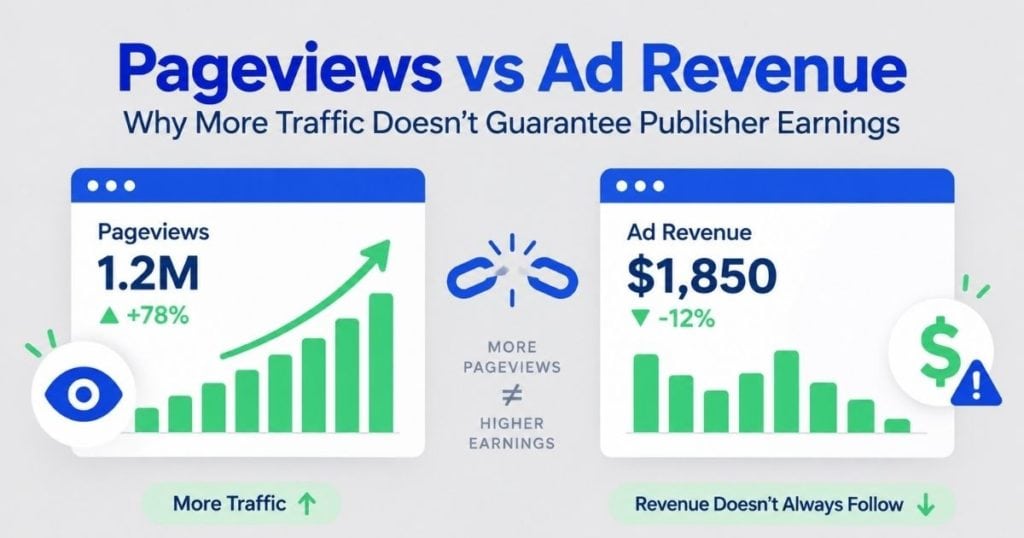
Pageviews and ad revenue are connected, but they do not grow at the same rate.
A publisher can double traffic without doubling revenue. Why? Because a pageview is only the beginning of the monetization process. Revenue depends on what happens after that visitor loads the page.
An ad request must be created. Demand must be available. A buyer must bid. The ad must render. The impression should ideally be viewable. And the winning bid must be valuable enough to generate meaningful revenue.
That is why publishers need to measure monetization quality, not traffic volume alone.
Key Takeaways
- More pageviews do not guarantee higher ad revenue.
- Fill rate directly affects monetized ad opportunities.
- Higher viewability can improve inventory value.
- Strong demand competition supports better publisher yield.
- Publishers should track RPM, eCPM, fill rate, and viewability together.
Why Doesn’t Every Pageview Generate Ad Revenue?
A pageview measures content consumption. It does not confirm that an ad was successfully monetized.
The actual path looks more like this:
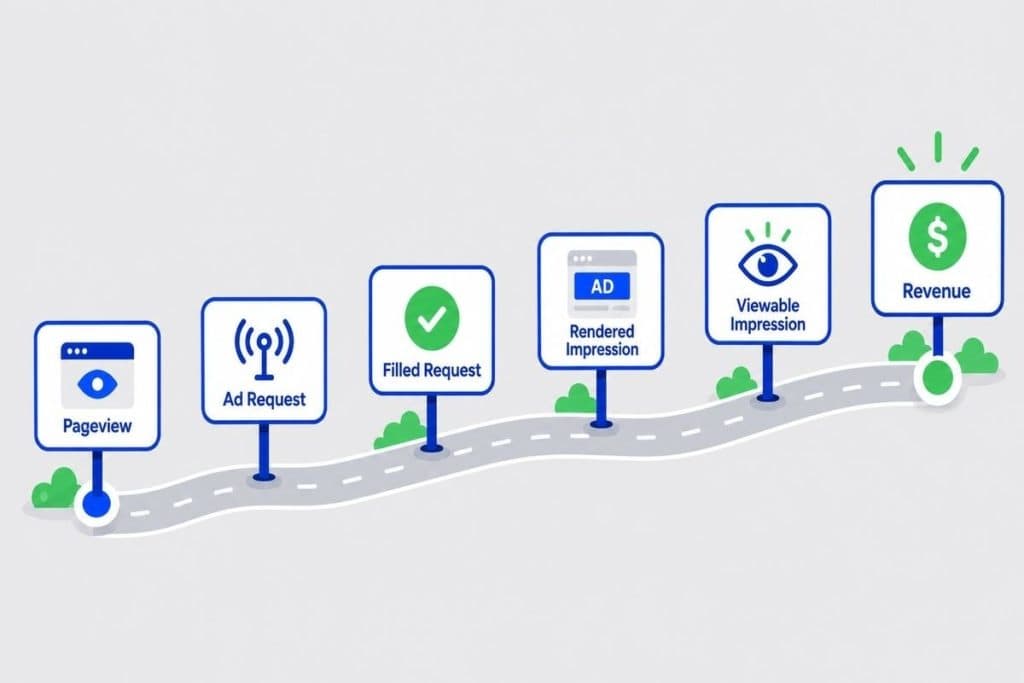
Revenue opportunities can disappear at every stage.
Google Ad Manager itself distinguishes between ad requests, responses, impressions, and viewable impressions. It notes that not every ad request finds a matching campaign, while some ads that are served never render or get seen.
So, when publishers ask why traffic increased but revenue did not, they should inspect this entire chain.
More Pageviews Do Not Mean More Ad Impressions
One pageview does not automatically equal one monetized ad impression.
Some pages may contain fewer ad placements. Consent choices can limit ad delivery. Technical errors may prevent ad calls. Certain visitors may also leave before an ad loads.
Then there are unfilled requests.
Google defines an unfilled impression as an ad request where no eligible ad was returned. In other words, the publisher created an opportunity but earned nothing from it.
This makes ad fill rate a critical metric.
Google calculates total fill rate as:
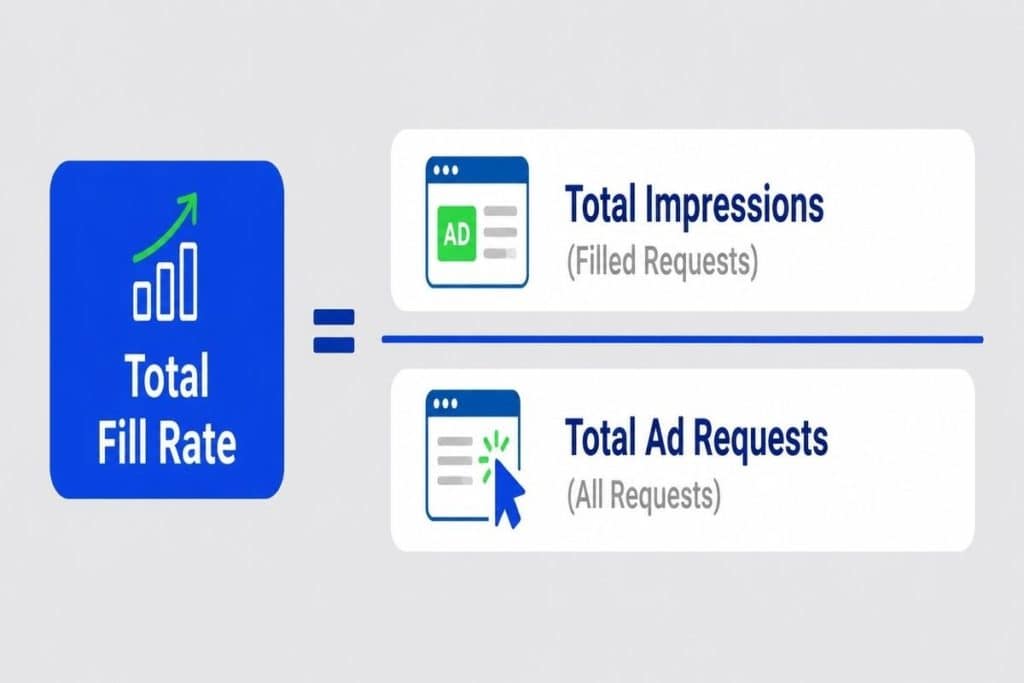
A publisher with growing traffic but weakening fill may therefore see little improvement in revenue.
An Impression Has Limited Value If Nobody Sees It
An ad can technically render and still create little value.
That is where ad viewability becomes important.
For standard display advertising, Google follows the industry definition of a viewable impression: at least 50% of the ad must remain visible for at least one continuous second. For in-stream video, it is two seconds.
The gap is meaningful.
DoubleVerify reported a 70% global Authentic Viewable Rate in 2024. Display stood at 69%, while video reached 76%.
This helps explain why two publishers with identical pageviews can generate very different publisher ad revenue.
One may produce inventory advertisers can actually see. The other may generate impressions with weaker visibility and demand value.
Audience Value Changes What Every Pageview Is Worth
Not all pageviews attract the same advertiser demand.
A visit from a commercially valuable market may receive several competitive bids. Another visitor may generate limited demand.
Revenue can differ based on:
- Geography
- Device type
- Content category
- Audience intent
- First-party signals
- Session depth
- Advertiser demand
- Seasonality
This is why page RPM often tells publishers more than total pageviews.
Traffic shows scale. RPM shows how effectively that scale is being monetized.
Weak Demand Competition Can Suppress Revenue
Even valuable inventory can underperform when too few qualified buyers compete for it.
This is one of the central challenges in programmatic monetization.
The wider digital advertising market is not lacking in spending. IAB and PwC reported that U.S. internet advertising revenue reached $294.6 billion in 2025, up 13.9% year over year.
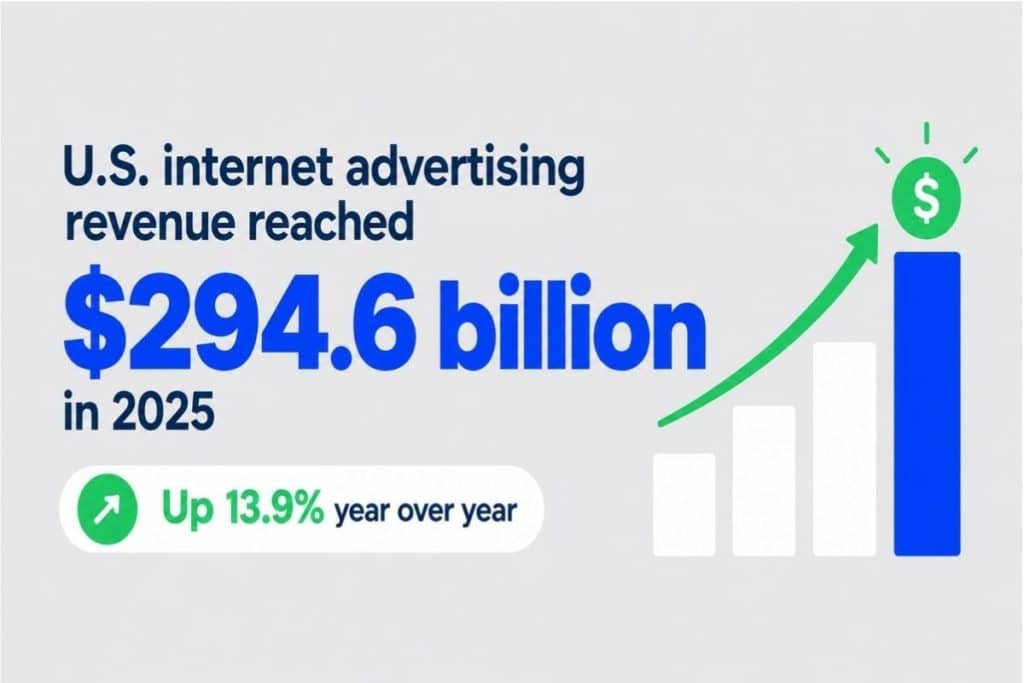
The publisher’s challenge is capturing an appropriate share of that demand.
That requires strong auction competition, effective demand connections, efficient supply paths, and inventory that buyers consider valuable.
Simply generating another pageview cannot solve weak auction dynamics.
Higher CPM Does Not Always Mean Higher Total Revenue
Publishers can also lose revenue by optimizing the wrong metric.
Consider floor pricing.
A high floor may increase reported CPM but reject bids that could otherwise generate revenue.
Google provides a useful example. With a fixed $2 CPM floor, only one auction was filled and produced $2.10 in revenue. Using a $2 target CPM allowed two auctions to fill. Average eCPM fell slightly to $2, but total revenue increased 95% to $4.
This is an important lesson in publisher yield optimization.
The objective is not to maximize CPM independently.
It is to maximize total sustainable revenue across fill rate, CPM, viewability, demand, and inventory quality.
What Should Publishers Measure Instead of Pageviews Alone?
Publishers should connect traffic analytics with monetization metrics.
Track:
- Page RPM to understand revenue generated per 1,000 pageviews.
- Fill rate to identify how many ad opportunities actually produce impressions.
- Viewability to understand whether ads have the opportunity to be seen.
- eCPM to monitor the value of monetized impressions.
- Unfilled impressions to identify lost revenue opportunities.
- Revenue per session to understand the full monetization value of a visitor.
Together, these metrics provide a far stronger view of ad revenue optimization than pageviews alone.
In The End
Traffic creates opportunity. Monetization infrastructure determines how much of that opportunity becomes revenue.
Auxo Ads helps publishers improve that conversion through advanced ad management, access to established premium demand ecosystems, stronger auction competition, yield optimization, inventory intelligence, and continuous monetization analysis.
Instead of focusing only on generating more traffic, publishers can work on making existing traffic more valuable.
Your pageviews are already creating opportunities. Make sure your monetization strategy captures more of them.
Visit Auxo Ads and discover how Auxo Ads can help strengthen your publisher monetization strategy.
More Traffic Is Useful. Smarter Monetization Is Better.
Frequently Asked Questions
1. Why do more pageviews not always increase ad revenue?
More pageviews increase traffic opportunities, but revenue also depends on fill rate, viewability, advertiser demand, audience quality, ad pricing, and how effectively publisher inventory is monetized.
2. What is the relationship between pageviews and ad revenue?
Pageviews create opportunities to serve ads, while ad revenue depends on how many requests become valuable impressions through strong demand, competitive auctions, good viewability, and effective monetization.
3. What is page RPM and why is it important?
Page RPM measures estimated revenue generated per thousand pageviews. It helps publishers understand how efficiently website traffic is monetized and compare revenue performance across pages, audiences, and periods.
4. How does ad fill rate affect publisher revenue?
Ad fill rate shows how many eligible ad requests receive ads. A low fill rate leaves monetization opportunities unused, limiting revenue even when website traffic and pageviews continue increasing.
5. How can publishers improve revenue without increasing pageviews?
Publishers can improve revenue by strengthening demand competition, increasing viewability, optimizing floors, reducing unfilled impressions, improving inventory quality, and continuously monitoring RPM, eCPM, and other yield metrics.