
CTV ad spend growth is affecting all publishers and how they approach video monetisation. The change is visible as audiences have moved from linear television to streaming. Therefore, new revenue opportunities are coming up in the market through:
- Premium inventory
- Programmatic demand
- Better targeting
But remember that fragmented measurement, ad fraud, privacy concerns, and viewer fatigue still create risks that require management. This blog aims to create awareness of opportunities and risks in the CTV domain.
| Quick Summary: CTV ad spend is rising as audiences and budgets shift from linear television to streaming. Publishers can benefit from premium inventory, programmatic demand, improved targeting and new ad formats. However, sustainable growth depends on transparent supply paths, reliable measurement, privacy controls, balanced ad loads and a viewer-first monetisation strategy overall. |
Key Takeaways
- CTV is gaining advertising budgets from linear TV, social media, search and display.
- Premium inventory and programmatic demand create new publisher revenue opportunities.
- Better metadata can improve targeting, pricing and brand suitability.
- Measurement gaps, fraud, privacy and excessive frequency remain major risks.
- Sustainable CTV monetisation must balance revenue growth with viewer experience.
What is Connected TV advertising?
Connected TV advertising delivers video ads through internet-connected televisions, streaming devices and broadcaster or streaming applications.
It uses the large-screen impact of traditional television with digital targeting, automated media buying and campaign measurement. Unlike linear TV, CTV advertising can serve different ads to households watching the same programme.
Difference Between CTV, OTT and OLV
People often use CTV, OTT and OLV interchangeably, but they describe different aspects of digital video advertising. Here’s a simple tabular differentiation:
| Term | Meaning | Where Content Is Viewed | Common Examples | Advertising Advantage |
| CTV | Connected TV refers to internet-connected television devices used to stream video content | Smart TVs, streaming devices and gaming consoles connected to a television. | Smart TV apps, Amazon Fire TV, Roku and Apple TV. | Delivers high-impact, large-screen ads with digital targeting and programmatic buying capabilities. |
| OTT | Over-the-top refers to video content delivered through the internet instead of traditional cable, satellite or broadcast television. | Televisions, smartphones, tablets, laptops and other internet-connected devices. | Streaming platforms, broadcaster applications and ad-supported video services. | Helps advertisers reach streaming audiences across multiple devices and content environments. |
| OLV | Online video refers to video advertising shown within websites, applications and digital platforms. | Desktop computers, laptops, smartphones and tablets. | In-stream video ads, social video, publisher websites and mobile applications. | Offers flexible formats, measurable engagement and broad audience reach across digital channels. |
In simple terms, OTT describes how content is delivered, CTV describes the device on which it is viewed, and OLV describes video advertising across general online environments.
Why CTV ad spend growth matters now
CTV is no longer an experimental media channel. According to IAB’s 2025 Digital Video Ad Spend & Strategy Report, 68% of advertisers described CTV as a “must buy”, placing it ahead of social video at 62%.
Martech highlights that most new spending is being reallocated from other channels. Among advertisers increasing CTV investment:
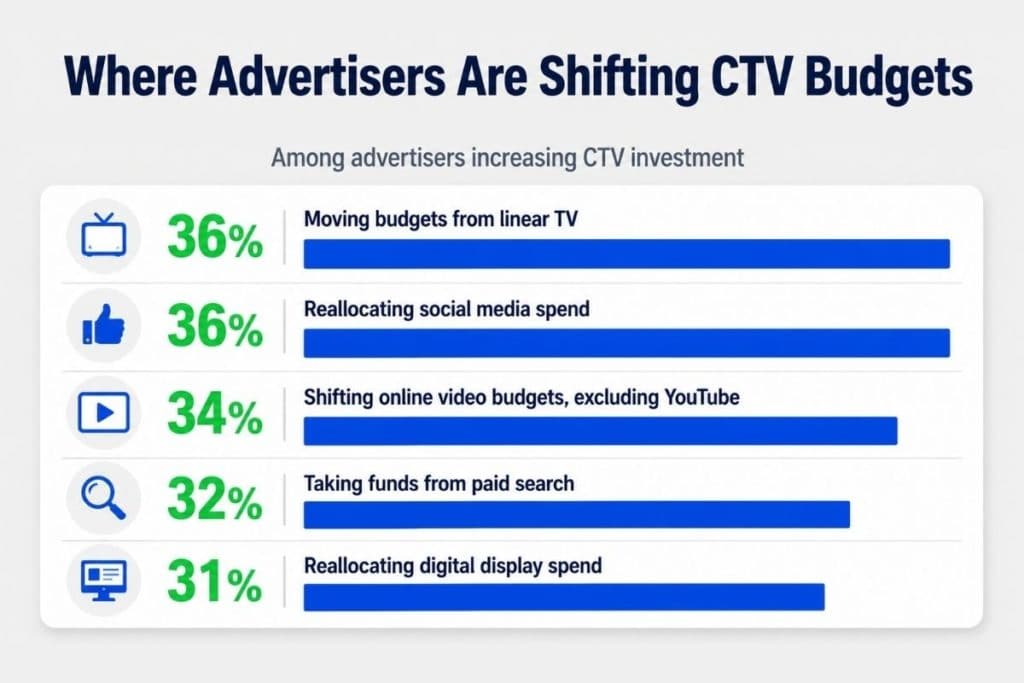
This shows that CTV is competing not only with television but also with established performance channels.
Market forecasts reinforce the shift. Interactive Advertising Bureau (IAB) projects US CTV spending to grow by approximately 13.8% in 2026. On the other hand, Omdia expects global CTV advertising revenue to rise from $44 billion in 2025 to $81 billion by 2030.
WARC-based industry analysis also places linear TV at only 12% of global ad spending and expects CTV to exceed 40% by 2030. It estimates that CTV already represents nearly half of viewing time.
MNTN Research also states that US spending could increase by almost $20 billion over five years, despite annual growth moderating from around 14% in 2026 to 11% by 2029.
Four CTV monetisation opportunities for publishers
Here are four CTV monetisation opportunities for smart publishers and professionals.
Higher-value CTV ad inventory
CTV ad inventory attracts advertisers seeking premium content, high video completion rates and the impact of the television screen.
Publishers can strengthen demand by accurately classifying
- Content
- Programmes
- Genres
- Live events
- Audience environments.
Also note that better metadata allows advertisers to understand what they are buying and can improve both pricing and brand suitability.
Programmatic CTV opens television to more advertisers
Programmatic CTV has lowered the operational and budget barriers that were traditionally associated with television advertising. Smaller advertisers that previously depended on search or social media can now reach streaming audiences.
For publishers, this creates a broader demand pool. But automated access should be supported by:
- Pricing controls
- Deal prioritisation
- Transparent supply paths
- Clear advertiser-quality standards
More revenue from every viewing hour
Broadband TV News expects that ad-supported CTV services could generate an average of $0.21 per hour viewed if every available advertising slot were sold.
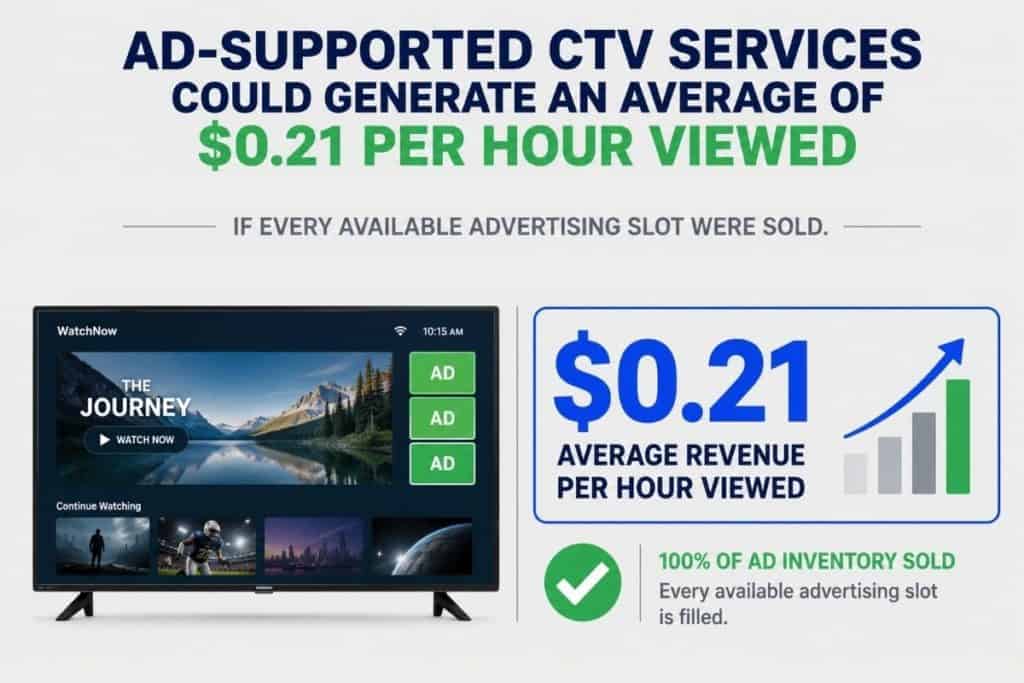
The research also suggests that the industry is currently operating at approximately 65% of its commercial capacity. This highlights an important publisher revenue optimisation opportunity: improve fill rates, demand competition and ad-break decisions without automatically increasing the number of ads.
New and less disruptive ad formats
Pause ads, menu ads, overlays, squeeze-back formats and shoppable experiences can create incremental revenue without copying long linear-TV commercial breaks.
Standardised signals are also making these formats easier to trade programmatically. Publishers should evaluate them using revenue per session, attention, completion rate and viewer retention, not CPM alone.
The biggest risks in CTV advertising
This section highlights some of the biggest risks in CTV advertising which you must keep in mind.
Fragmented CTV measurement
CTV measurement remains inconsistent across platforms. Impressions, co-viewing, reach, frequency and attention may be calculated differently, making campaign comparisons difficult.
IAB warns that fragmented standards and uneven signal quality can undermine accurate measurement and buyer confidence.
CTV ad fraud and supply-chain opacity
App spoofing, unauthorised reselling and unclear intermediary relationships can divert advertising spend away from legitimate publishers.
Publishers should maintain accurate app-ads.txt, ads.txt and sellers.json records while reducing unnecessary supply-chain hops. These standards help buyers confirm who owns inventory and who is authorised to sell it.
Poor frequency management
The same household may encounter one campaign repeatedly across different streaming applications and devices. Without cross-platform frequency controls, increased spend can cause viewer fatigue rather than incremental reach.
Privacy and identity exposure
CTV targeting can combine household, device and viewing signals. Publishers need consent-aware data practices, clear vendor governance and targeting strategies that do not depend entirely on unrestricted identifiers.
Excessive ad loads
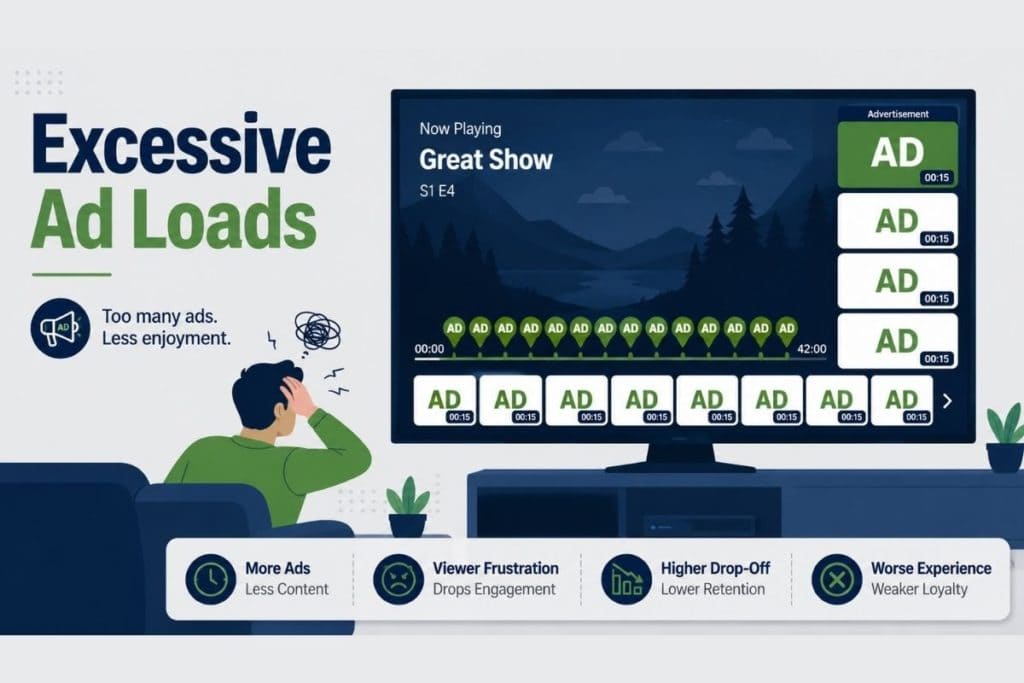
More commercial breaks may increase short-term revenue but also cause viewers to abandon content. Sustainable CTV monetisation requires balancing fill and CPM with session length, retention and overall revenue per viewing hour.
How publishers can capture CTV growth safely
Begin by auditing inventory ownership, application identifiers, content metadata, consent signals and authorised sellers.
Next, establish a monetisation setup that can compare direct campaigns, private marketplace deals and open-auction demand without sacrificing pricing control. Enterprise-grade ad serving, premium monetisation access and multiple reputable demand relationships can improve competition and reduce reliance on one buying route.
Publishers should monitor:
- Revenue per viewing hour
- Fill rate and bid density
- Video completion rate
- Unique reach and frequency
- Ad latency
- Session abandonment
- Supply-path efficiency
Note that a high CPM is not meaningful when poor fill, repeated exposure or slow ad delivery reduces total viewing and revenue.
Summing Up
CTV ad spend growth gives publishers access to expanding video budgets, but rising demand alone will not guarantee higher revenue. Success requires transparent programmatic access, strong yield controls, reliable measurement and an ad experience that keeps viewers watching.
Explore Auxo Ads to strengthen your video monetisation strategy and create a more efficient connection between premium inventory and quality advertising demand.
Want publisher growth insights without the AdTech noise? Visit the Auxo Ads blog for practical strategies that turn industry changes into measurable revenue.
Frequently Asked Questions
- Why is CTV ad spend growing?
CTV ad spend is growing because audiences are shifting from linear television to streaming, while advertisers value large-screen impact, addressable targeting, measurable outcomes and scalable programmatic buying across premium environments.
- How can publishers monetise CTV inventory?
Publishers can monetise CTV inventory through premium direct deals, private marketplaces and programmatic auctions while improving metadata, fill rates, pricing controls, demand competition and viewer-friendly ad experiences efficiently at scale.
- What are the biggest risks in CTV advertising?
The biggest CTV advertising risks include fragmented measurement, ad fraud, supply-chain opacity, privacy concerns, repeated exposure, weak frequency controls, latency and excessive ad loads that reduce viewer retention over time.
- What is the difference between CTV, OTT and OLV?
CTV describes the connected television device, OTT describes internet-delivered video content, and OLV refers to digital video advertising viewed across websites, apps, computers, smartphones, tablets and other online environments globally.
- How does programmatic CTV benefit publishers?
Programmatic CTV makes television advertising more accessible by automating buying, lowering budget barriers and connecting publishers with broader demand, but transparent supply paths and quality controls remain essential for growth.







Getting started here was incredibly smooth since the installer works flawlessly on both android and ios devices. I enjoy the daily reload offers and the way the VIP program scales rewards for loyal members. It is hands down the most convenient way to play on the go right now. li789appdownload
Security and quick payouts are my top priorities and this site delivers on both fronts. I tested the deposit methods and everything processed instantly. It is refreshing to play on a platform that respects its users and keeps things transparent from start to finish. br8787bet
Logging in is always a breeze on this platform and that alone makes a huge difference. I enjoy how they personalize the game recommendations based on my habits. The customer service team actually remembers your name which makes me feel valued. A solid choice for both casual and serious players. hb888casinologin
The slot variety here is insane. I love how the games load quickly without any glitches. Definitely my new go-to place for some fun spins at brasil777slots.
Super fast loading times and the graphics are top notch. It feels like a real casino right on my phone. Give ph998jili a go!
The loading speed is amazing and the graphics are top notch. I had a lucky streak yesterday thanks to pkm555.
Great vibes and even better rewards. I feel like I actually have a chance to win big here compared to other sites. krlucklandcasino is the real deal.
Finally found a reliable login link that actually works without any lag. Highly recommend this site for everyone. Visit j8jililogin
Finally found an app that doesn’t lag during big wins. The bonus offers are actually fair and easy to claim. Give pkb9app a try guys, it’s a game changer.
Just tried it out and I am loving the vibe. The setup was a breeze and the gameplay is addictive. bdjoya9app is definitely my new favorite.
Best platform for local players. The registration was easy and I started playing within minutes. Definitely visit 168jllogin.
The app version is so much better than the browser. Installation was a breeze and the graphics are top notch. Great job on 7gameasiaapk.
I’ve been looking for a reliable platform like this for a while. The interface is super smooth and everything loads quickly. Highly recommend phrotowire for anyone starting out!
If you are looking for something reliable and fast, this is it. The payouts are processed quickly and the games are addictive. Check out ft999app
Finally found a place where the payouts are actually fair and fast. The games are super addictive and the graphics are top notch. Love krwin35
[8697]cv999 Login Link | Online Slots na may Gcash Deposit,Gamitin ang cv999 login link para sa mabilis na access. Download cv999 APK para sa best live casino app at alamin kung paano maglaro ng baccarat. Sali na! visit: cv999
The mobile app version is a game changer. I can play whenever I want without any lag. For the best mobile experience, you need 119betapp.
Love how easy it is to manage my account here. No complicated steps, just pure gaming. I always use 777ucasinologin whenever I want to relax and play.
Signing up was a breeze and the welcome bonus really helped me get started. Great customer support too. Register now at jili188loginregister for the best deals.
The rewards here are insane compared to other places I’ve tried. Really feeling the luck on this site lately ph777bar
Just downloaded the app and it works like a charm. The installation process was super quick and it doesn’t lag at all. Definitely check out in777download if you prefer playing on mobile.
[9821]Bro178: Login Daftar Slot Gacor Dana Tanpa Potongan,Bro178 menyediakan akses login daftar mudah untuk slot gacor dana tanpa potongan. Download apk casino terpercaya dan pelajari cara main baccarat online di sini. visit: bro178
Finally a site that doesn’t lag during peak hours. The login process is quick and everything just works perfectly on my phone. I always use jili30login for my daily gaming sessions.
Downloading the app was the best decision. It is much faster than the browser version and the lag is gone. Get the 389winappapk
The bonuses here are actually worth it. I managed to win a decent amount today thanks to their promo. Visit balivegas188 and see for yourself.
Super easy to navigate and very user friendly. I love how fast the page loads on my mobile phone. Great job on jljl9login.
Logging in is so quick and the site doesn’t lag at all. I love how easy it is to manage my account here. winjiliphlogin is the way to go.
I love how easy it is to track my progress here. The login process is secure and fast. paitoangkalogin is definitely my go-to now.