
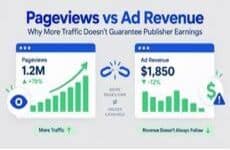
Traffic is growing, pageviews look healthy, but publisher monetization is barely moving. For publishers, this is one of the most frustrating revenue problems because the audience is already there. The issue is often not traffic acquisition. It is what happens between a user arriving on the page and an advertiser paying for that impression.
Many gaps can all turn valuable traffic into missed revenue.
The real question is not, “How much traffic are we getting?”
It is, “How effectively are we monetizing every eligible visit?”
This blog aims to uncover hidden publisher monetization mistakes that cause high traffic but low revenue.
| Quick Summary: High traffic does not automatically translate into higher publisher revenue. Monetization can suffer from poor traffic quality, weak auction competition, incorrect floor pricing, ad latency, low viewability, excessive ad density, configuration errors, and limited audience signals. Publishers should optimise the complete journey from ad request to revenue generation more efficiently. |
Key Takeaways
- High traffic does not automatically mean higher ad revenue.
- Latency and low viewability can silently reduce monetizable impressions.
- Poor floor pricing can hurt both fill rate and overall yield.
- Strong demand competition matters more than simply adding demand partners.
- Track revenue per session alongside eCPM, fill rate and viewability.
Why Does High Traffic Not Always Increase Publisher Ad Revenue?
High traffic does not guarantee high publisher ad revenue because visits only create revenue when they generate eligible, filled, viewable and competitively priced ad impressions.
In simple terms:
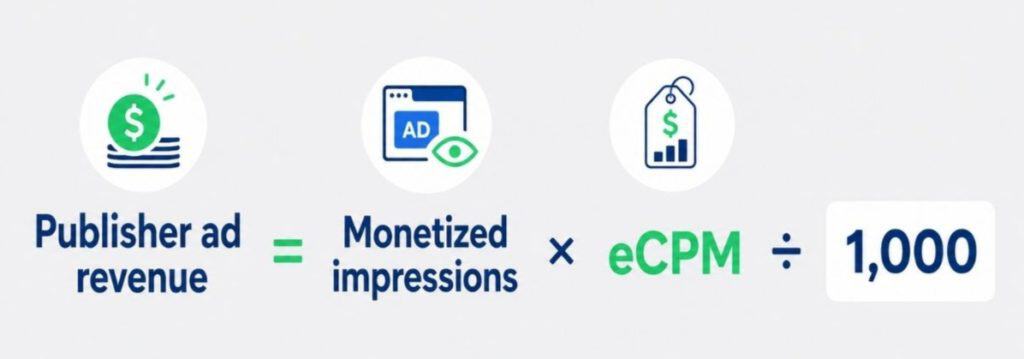
Traffic sits upstream of that equation. A publisher can increase pageviews significantly while revenue stays flat if fill rate falls, advertisers bid less, ads load too late or high-value impressions are never seen.
That is why publishers experiencing traffic growth without corresponding revenue growth should investigate monetization efficiency before chasing more users.
You Are Measuring Traffic Instead of Monetizable Traffic
A million pageviews are not necessarily a million equally valuable opportunities.
Traffic Quality Changes What Advertisers Will Pay
Audience geography, device type, content category, session depth, referral source, engagement and advertiser demand can cause two pages with similar traffic to generate completely different eCPMs.
For example, sudden traffic growth from a geography with limited advertiser demand may lift pageviews considerably without producing the same increase in programmatic advertising revenue.
Instead of analysing traffic as one number, publishers should compare revenue per session and page RPM across geography, device, content category, acquisition source and page template. That reveals which audience segments are actually creating monetizable value.
Your Auctions Do Not Have Enough Meaningful Competition
More traffic cannot fix an auction in which too few relevant buyers are competing.
More Demand Partners Do Not Automatically Mean More Revenue
Auction quality depends on the quality, relevance and competitiveness of demand, not simply the number of integrations.
If inventory repeatedly reaches the same limited demand pool, bid density can remain weak. At the other extreme, an overly complicated setup can introduce duplicate demand, unnecessary calls and additional latency.
Effective ad revenue optimization requires a balanced monetization architecture that combines enterprise-grade ad serving, premium demand access and competition across multiple high-quality exchanges.
Publishers should examine bidder participation, bid rates, win rates, timeouts and revenue contribution rather than assuming every connected source is adding incremental value. This will helping in increasing publisher monetization.
Your Floor Prices Are Working Against You
Floor prices can protect inventory value. Poorly configured floors can destroy it.
A Floor That Is Too High Can Reduce Fill Rate
If a floor consistently exceeds what advertisers are willing to bid, auctions go unfilled. Traffic remains unchanged, but the percentage of impressions producing revenue declines.
Set floors too low, however, and premium inventory may clear below its potential value.
A single site-wide floor is therefore rarely sufficient. Floors should reflect differences in geography, device, format, placement, viewability and historical demand. Publishers should evaluate fill rate and eCPM together, because increasing one while damaging the other may reduce total revenue.
The target is not the highest CPM. It is the highest sustainable yield.
Ad Latency Is Silently Removing Monetization Opportunities
A user can visit a page, read the content and leave before an ad finishes loading.
For the analytics platform, that session still counts as traffic. For monetization, the opportunity may already be lost.
Even One Extra Second Can Affect Impressions
Google analysed an experiment covering 4 billion ad impressions in which artificial delays were introduced before ad responses. With one additional second of delay:
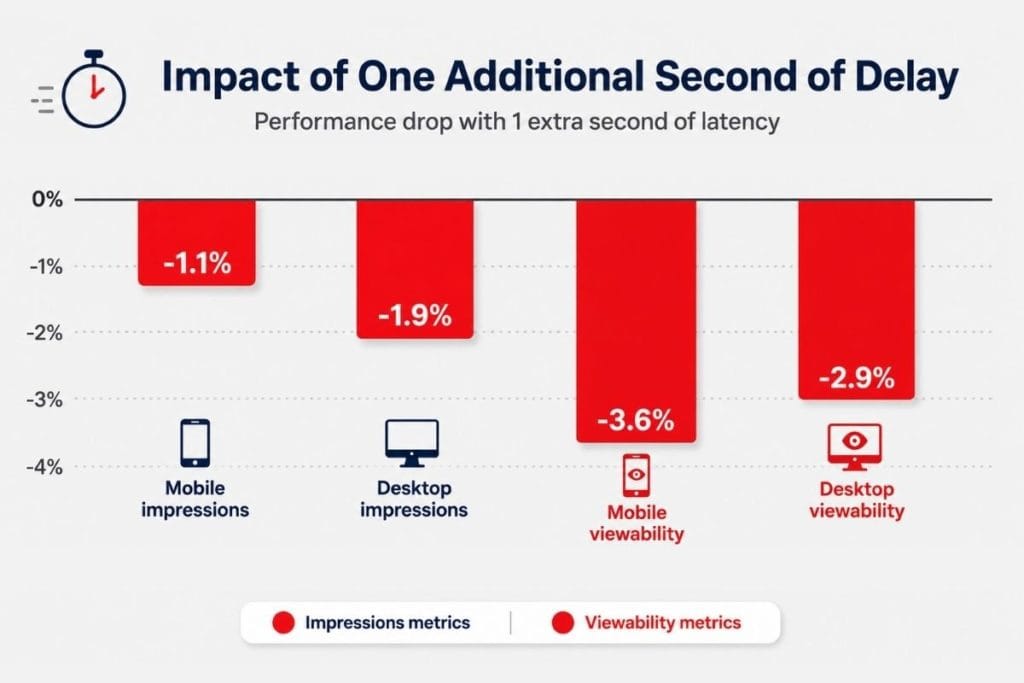
For high-volume publishers, even a seemingly small percentage can translate into a meaningful amount of lost inventory.
Publishers should audit:
- Ad latency
- Bidder timeouts
- Excessive client-side calls
- Passbacks
- Heavy scripts
- Poorly configured lazy loading
Faster bidding is not simply a UX improvement; it protects monetizable impressions.
Your Ads Are Served but Not Actually Seen
An impression being served does not necessarily mean an advertiser received meaningful exposure.
Ad Viewability Directly Affects Inventory Quality
The standard viewability threshold counts a display ad as viewable when at least 50% of the ad is visible for one continuous second. For video, the threshold is at least 50% for two continuous seconds.
DoubleVerify’s 2025 findings reported a 70% global Authentic Viewable Rate, based on research drawing from more than one trillion impressions across desktop, mobile and CTV environments.
That makes ad viewability a critical quality signal rather than a secondary reporting metric.
Units placed too far below the fold, ads that render after users scroll past them or poorly designed mobile placements can create impressions without delivering enough advertiser value.
Publishers should optimise placements for viewability and engagement, not simply the maximum number of available slots. It’ll aid in better publsisher monetization.
You Are Adding More Ads Instead of Increasing Revenue per Session
When revenue underperforms, adding another ad unit can look like the fastest solution.
It can also make the underlying problem worse.
Excessive ad density may:
- Slow pages
- Interrupt content consumption
- Reduce session depth
Users who view fewer pages create fewer total monetization opportunities, even if the first page contains more ads.
Effective website monetization therefore focuses on the value of the complete session.
The better question is not, “How many ads can this page hold?”
It is, “Which combination of placements produces the highest revenue without damaging engagement?”
Sometimes fewer, faster and better-positioned ads generate more value than a crowded page.
Revenue Is Leaking Through Supply-Chain and Configuration Errors
Some monetization losses never appear as a dramatic dashboard warning.
Incorrect seller entries, missing sizes, broken key-values, outdated inventory rules, targeting conflicts, consent signal failures or unnecessary passbacks can quietly prevent demand from reaching eligible impressions.
Supply-chain transparency also matters. IAB Tech Lab explains that ads.txt allows publishers to publicly declare which companies are authorised to sell their inventory, helping buyers identify legitimate supply paths and reducing opportunities for counterfeit inventory.
Publishers should therefore audit their monetization configuration regularly rather than treating implementation as a one-time exercise.
Traffic changes. Demand changes. Buyer requirements change. The setup needs to change with them.
You Are Not Giving Buyers Enough Privacy-Safe Signals
As addressability changes, traffic without useful signals can become harder for buyers to evaluate.
A large-scale research study covering 42 million web impressions and 218 million mobile in-app impressions found average ad-impression price decreases of approximately 18% and 23% respectively when user tracking was unavailable, although the impact varied substantially between publishers.
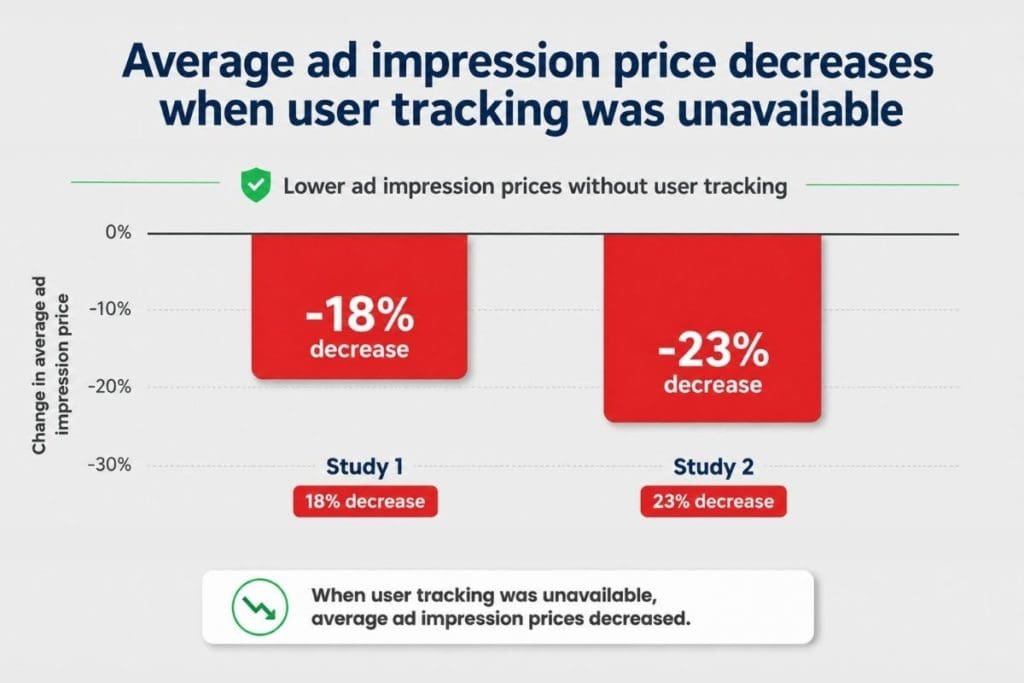
This does not mean publishers should pursue invasive tracking.
It highlights the importance of building stronger privacy-conscious signals through consented:
- First-party data
- Contextual information
- Content taxonomy
- Meaningful audience segmentation
Publishers with strong contextual understanding can help advertisers evaluate inventory even as traditional identifiers become less dependable.
How To Find the Real Publisher Monetization Leak?
Do not diagnose low revenue from eCPM alone.
Evaluate page RPM, session revenue, fill rate, ad viewability, ad latency, bid rate, win rate, timeout rate and revenue by geography, device, placement and demand source together.
Patterns reveal the problem:
- If traffic grows while ad requests grow but revenue does not, inspect fill and demand competition.
- If impressions grow but revenue per thousand impressions falls, investigate pricing and traffic mix.
- If requests are healthy but impressions lag, examine latency, timeouts and technical errors.
- If eCPM is strong but revenue per session is weak, investigate viewability, page depth and inventory design.
The goal is to identify where value disappears between the pageview and the paid impression.
What To Optimise First for Good Publisher Monetization?
To have better publisher monetization, start with the areas that affect the widest share of inventory.
- Fix technical delivery and latency first so monetization opportunities are not disappearing before the auction completes.
- Then improve viewability and placement quality.
- After that, strengthen demand competition, refine floor pricing, validate supply paths and segment inventory using real performance data.
Most importantly, test changes against total publisher ad revenue and revenue per session, rather than celebrating an isolated CPM increase.
A higher eCPM means very little if the change also reduces fill rate and produces less overall revenue.
High Traffic Is Potential Revenue, Not Guaranteed Revenue
Good publisher monetization is complex. More traffic is valuable only when the monetization system can convert that attention into competitive, viewable and properly priced impressions.
When traffic rises but revenue does not, publishers should stop assuming they have an audience problem.
They may have a monetization efficiency problem.
Finding that gap requires looking beyond pageviews and optimising the complete path from ad request → auction → bid → impression → viewability → revenue.
Turn More of Your Traffic Into Revenue With Auxo Ads
Your audience is already creating opportunities. The next step is ensuring those opportunities do not disappear through weak demand, inefficient auctions, poor viewability, latency or configuration gaps.
Explore Auxo Ads and discover how a stronger, data-driven publisher monetization setup can help you improve yield, increase competition and unlock more revenue from the traffic you already have.
More Traffic Is Good. Knowing How to Monetize It Is Better.
Want practical strategies on programmatic advertising, publisher revenue, yield optimization and the changing AdTech ecosystem?
Visit the Auxo Ads Blog and subscribe to the newsletter.
Your next revenue breakthrough might already be hiding in your data.
Frequently Asked Questions
1. Why can a publisher have high traffic but low revenue?
High traffic does not guarantee revenue because monetization depends on fill rate, eCPM, viewability, demand competition, latency, audience quality, and how efficiently each eligible impression converts into overall advertiser value.
2. How does ad latency affect publisher revenue?
Ad latency can delay auctions and ad rendering, causing users to leave or scroll past placements before ads load. This reduces impressions, viewability, fill opportunities, and overall programmatic advertising revenue.
3. What is the best way to improve publisher monetization?
Publishers should improve technical delivery, ad viewability, demand competition, floor pricing, inventory segmentation, and supply path quality while measuring total revenue per session instead of focusing only on eCPM alone.
4. Can increasing ad density improve website monetization?
Not always. Adding more ads can slow pages, reduce engagement, and shorten sessions. Publishers should prioritise well placed, viewable, fast loading units that maximise total session revenue and user experience.
5. Which metrics should publishers track to identify revenue leakage?
Publishers should monitor page RPM, session revenue, fill rate, eCPM, ad viewability, latency, bid rate, win rate, timeouts, and revenue by device, geography, placement, and demand source consistently over time.






[6872]bt222 Official Login | Legit Online Casino at Mabilis na GCash,Mag-login sa bt222 para sa legit na casino experience. I-download ang app at subukan ang pinakamabilis na GCash withdrawal at mga slots. Sali na at maglaro ngayon! visit: bt222
Finally found a platform that doesn’t lag during peak hours. The customer support is also very responsive which gives me peace of mind. Big thanks to phvipphfun
[8382]Wib4d: Login Daftar Situs Slot Deposit Dana Terpercaya,wib4d menyediakan akses login mudah dan daftar wib4d apk untuk judi casino online terpercaya. Pelajari cara main slot gacor dan mulai bermain sekarang. visit: wib4d
Honestly, the variety of games here is impressive. I spent the whole weekend exploring and didn’t get bored once. Great experience overall 55llcombet
The registration process was super fast and I was able to start playing in minutes. Highly recommend jili999loginregister to everyone.
The atmosphere of this casino is top notch. It really feels like a premium experience from the moment you sign up. Visit parkjilicasino today.
The name says it all. Quick wins and even quicker withdrawals. I love how intuitive the layout is, makes playing so much more relaxing. Cheers to krquickwin!
Clean design and very straightforward registration process. I was able to start playing in less than two minutes. Visit win444betoficial for a great experience.
Great vibes and even better rewards. I love how easy it is to navigate through the different sections. Keep it up! vndt168
Best platform I have used in a long time. The payouts are fast and the games are fair. Highly recommend br3365bet to everyone.
Finally found a platform that doesn’t lag during the peak hours. The login process is seamless and everything just works perfectly. lucky999gamelogin
Best platform for local players in the Philippines! The customer support is actually helpful and responsive. Just visit arionplaycomph to start winning.
The interface is very user-friendly and the payouts are legit. I’ve been playing here for a week and I’m loving the vibe at phbw29.