Last time, we discussed ‘CPM vs RPM’; now I’m adding one more word to the discussion.
DRUMROLL!!
Today the topic of discussion is ‘CPM vs RPM vs eCPM’. For those who don’t know the difference, I’ll explain in simple words, and for those who know these terms, you can still read the article to brush up on your knowledge 😉
When we talk about ‘CPM vs RPM vs eCPM’, they can seem like three versions of the same number. BUT, they aren’t. Each metric talks about a different monetization question. Don’t confuse them, or else you’ll end up with:
- bad pricing decisions
- misleading demand comparisons
- missed publisher revenue
That’s why it’s important to understand the distinction more when digital advertising keeps growing. IAB and PwC reported that U.S. internet advertising revenue reached $294.6 billion in 2025, up 13.9% year over year.
CPM vs RPM vs eCPM: What Is the Difference?
The simplest answer is:
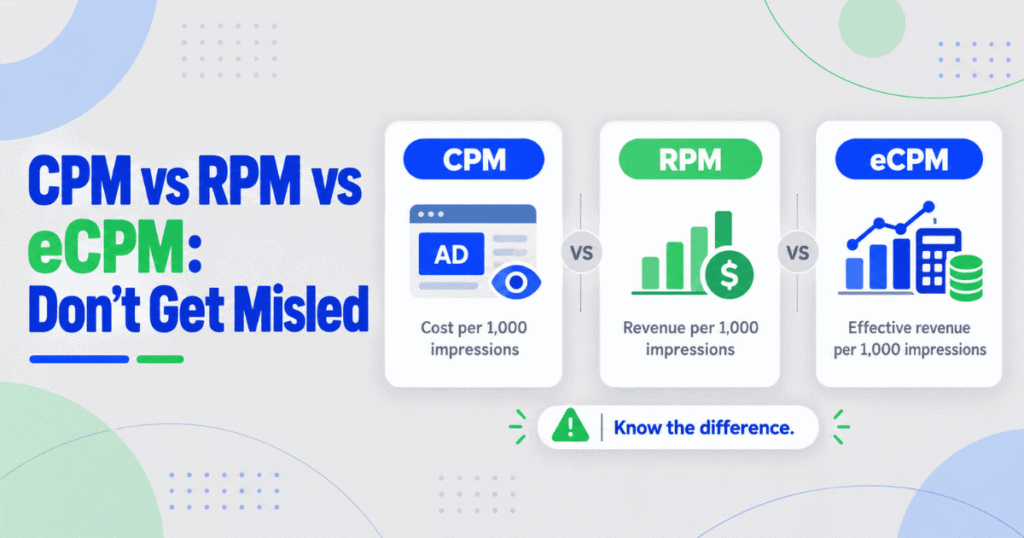
- CPM is a pricing rate
- eCPM is an effective performance rate
- RPM is a publisher revenue-efficiency metric
For better clarity, here’s a tabular representation:
| Metric | What it measures | Basic formula | Best used for |
| CPM | Price or value per 1,000 ad impressions | Cost or revenue ÷ impressions × 1,000 | Pricing inventory and CPM-based deals |
| eCPM | Effective revenue per 1,000 impressions | Revenue ÷ impressions × 1,000 | Comparing monetization performance |
| RPM | Publisher earnings per 1,000 measured units | Earnings ÷ pageviews, impressions or requests × 1,000 | Measuring overall monetization efficiency |
Note: The catch is the denominator. “Per thousand” means little unless you know per thousand what.
What Is CPM in Programmatic Advertising?
CPM stands for cost per mille.
It is the price for 1,000 ad views. It is a standard ad pricing metric.
For instance:
If an advertiser agrees to a ₹200 CPM, they are basically saying: “I’ll pay ₹200 for every 1,000 times my ad is shown.”
Note that:
- From the buy side, CPM reflects media cost.
- From the sell side, it represents the booked or transacted rate attached to publisher ad inventory.
Publishers use programmatic advertising CPM to assess:
- inventory pricing
- floor strategies
- direct deals
- ad formats
- Geographies
- audience segments
Simple question CPM answers: How much are 1,000 ad impressions worth or being sold for?
But a high CPM alone does not prove strong monetization. It says little about unfilled requests or total inventory monetized.
What Is eCPM and Why Does It Matter?
eCPM stands for effective cost per mille.
It is what you actually earned per 1,000 ad impressions. eCPM in advertising is useful when different demand sources or pricing models need to be compared. Google Ad Manager, for example, reports total average eCPM across its ad server and multiple monetization sources.
For instance:
Suppose your website showed 10,000 ads and earned ₹1,500. Your eCPM would be:
₹1,500 ÷ 10,000 × 1,000 = ₹150 eCPM.
eCPM helps you in understanding:
- demand-source analysis
- yield optimization
- auction performance
- ad inventory benchmarking
But remember that eCPM can still mislead. Google explains that ad requests, matched responses and rendered impressions can generate different eCPMs. Why? Because volume drops at different stages of ad delivery.
Simple question eCPM answers: For every 1,000 ads I actually showed, how much money did I make?
What Is RPM for Publishers?
RPM stands for revenue per mille.
It shows how much estimated revenue a publisher generates per 1,000 units being measured.
The important word is measured.
Google AdSense defines RPM as estimated earnings divided by pageviews, impressions, or queries, multiplied by 1,000.
That means page RPM, impression RPM, and ad request RPM are not interchangeable.
For instance:
If your site gets 100,000 pageviews and earns ₹20,000, your Page RPM is:
₹20,000 ÷ 100,000 × 1,000 = ₹200 RPM.
Publisher RPM connects publisher ad revenue with the traffic or inventory base that generated it. It is often a stronger top-level indicator of publisher monetization performance than CPM alone.
Remember that a good RPM for publishers depends on various factors.
Simple question RPM answers: For every 1,000 pageviews or units of traffic, how much money am I making overall?
A very easy way to remember these three terms is:
| Metric | Think of it as | Main question |
| CPM | The price tag | What does 1,000 ad views cost? |
| eCPM | The actual earning rate | What did 1,000 ad impressions actually earn? |
| RPM | The overall monetization rate | How much revenue did 1,000 pageviews/units generate? |
Why Can a Higher CPM or eCPM Still Mean Lower Revenue?
This is where publishers often get misled.
Suppose you raise a price floor and eCPM increases. That looks positive. But if fill rate falls sharply, total revenue may decline.
Google Ad Manager provides a useful example.
With a fixed $2 floor, one opportunity filled and generated $2.10. With a $2 target CPM, two opportunities filled. The resulting eCPM fell roughly 5%, from $2.10 to $2.00, while total revenue increased about 95%, from $2.10 to $4.
That illustrates why understanding ‘fill rate vs CPM’ matters.
You must not optimize CPM or eCPM in isolation. Read them alongside fill rate, viewability, ad requests, RPM and total publisher revenue.
Which Metric Should Publishers Use?
I’ll repeat again:
- Use CPM when you want to know: What is this inventory priced at?
- Use eCPM when you want to know: How effectively is this demand source or monetization route generating revenue per 1,000 impressions?
- Use RPM when you want to know: How efficiently is my traffic, page inventory or ad-request volume turning into revenue?
For publishers and AdTech teams, the strongest analysis combines all three. A healthy monetization stack balances pricing power, demand competition, fill, and revenue instead of chasing one headline number.
CPM vs RPM vs eCPM: The Rule That Prevents Bad Comparisons
Before comparing two publisher monetization metrics, you must check the:
- numerator
- denominator
- stage of the ad-delivery funnel
If one dashboard reports page RPM while another reports impression eCPM, then don’t treat those numbers as equivalent.
This simple check can prevent misleading conclusions about ad inventory performance.
In the End
By now, you must have understood the whole discussion over ‘CPM vs RPM vs eCPM’. Well, at least I hope you did. If not, then let me tell you ONE LAST TIME!
- CPM helps explain price
- eCPM normalises impression-level performance
- RPM shows how efficiently publisher traffic turns into revenue
Your real goal shouldn’t be the highest CPM on a dashboard. It should be stronger, sustainable ad inventory yield across the complete monetization setup.
If you want to turn better metrics into better yield, then choose Auxo Ads. Explore Auxo Ads and strengthen your publisher monetization strategy
Want more practical insights on publisher monetization, programmatic advertising, revenue optimization, and AdTech?
Visit the Auxo Ads Blog for more publisher insights and follow Auxo Ads on LinkedIn.
Frequently Asked Questions
1. What is the main difference between CPM, eCPM and RPM?
CPM shows the cost of 1,000 ad impressions, eCPM shows effective earnings per 1,000 impressions, while RPM measures revenue generated per 1,000 pageviews or other units.
2. Is eCPM the same as CPM?
No. CPM is usually a pricing metric, while eCPM measures actual revenue performance per 1,000 impressions. eCPM helps publishers compare monetization across different demand sources.
3. Why is RPM important for publishers?
RPM helps publishers understand how efficiently their traffic generates revenue. It provides a broader view of monetization performance than CPM alone, especially when comparing pages or traffic segments.
4. Can a higher CPM result in lower publisher revenue?
Yes. A higher CPM may reduce fill rate or monetized impressions. Publishers should evaluate CPM alongside fill rate, eCPM, RPM and total revenue before making optimization decisions.
5. Which metric should publishers focus on: CPM, eCPM or RPM?
Publishers should use all three. CPM measures pricing, eCPM compares impression-level performance, and RPM evaluates overall revenue efficiency across traffic, pageviews or ad inventory.