
I googled “CPM vs RPM” and went through a lot of webpages, only to get confused. I frequently get confused between these two terms and somehow keep forgetting the difference. (P.S. Don’t tell me to eat almonds cause they don’t work for me).
But I’ve finally understood them and will break it down for you. If you work in digital publishing, then understanding the difference between the two is important.
Note that both metrics use 1,000 impressions as a reference point. But the catch is that both answer very different questions.
- CPM tells you the value or cost of ad impressions.
- RPM tells you how effectively those impressions or pageviews turn into publisher revenue.
Yep, that still sounds confusing, at least it does to me. Don’t worry, I’ll make it simpler. Know that you must understand these basic differences as the digital advertising market continues to grow.
Grand View Research reports that the global digital advertising market size was valued at $567.9 billion in 2025. It is further expected to grow from $662.3 billion in 2026 to USD 1,692.9 billion by 2033.
The market is growing at a CAGR of 14.3% from 2026 to 2033. Such huge numbers, right? The digital advertising market is rolling up for sure.
So, let’s update our knowledge bank related to this domain.
CPM vs RPM: What Is the Difference?
To break it down in simple terms:
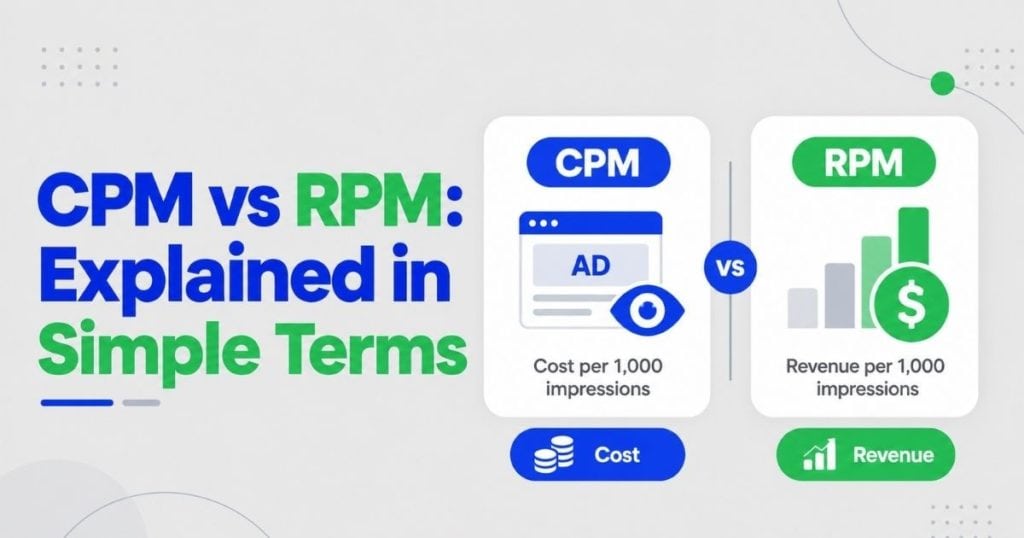
- CPM = the value of 1,000 ad impressions.
- RPM = the revenue a publisher earns per 1,000 impressions or pageviews.
The easiest way to remember it is:
- CPM = What advertisers pay
- RPM = What publishers earn
CPM focuses more closely on the price of advertising inventory.
RPM gives publishers a broader view of monetization performance.
That is why a publisher can have a strong CPM but still see a disappointing RPM.
What Is CPM in Advertising?
CPM stands for Cost Per Mille, where “mille” means one thousand.
It shows the amount associated with 1,000 ad impressions.
Google defines CPM as a pricing model based on every 1,000 impressions.
CPM Formula
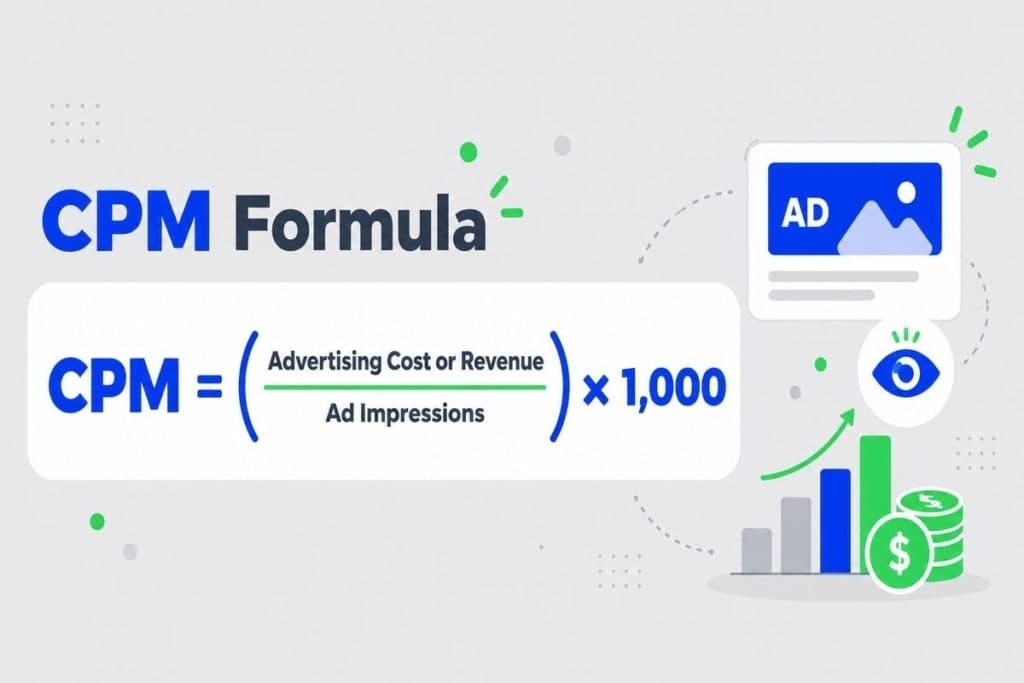
For example, if 100,000 impressions generate $500:
CPM = ($500 ÷ 100,000) × 1,000 = $5
The CPM is therefore $5.
For publishers, ad CPM helps show how valuable monetized inventory is to advertisers and buyers.
Want to increase your CPM? Many factors such as audience geography, content category, device, seasonality, ad format, viewability, and demand competition can all influence CPM growth.
What Is RPM?
Now, coming to RPM, it stands for Revenue Per Mille.
It calculates how much estimated revenue a publisher generates for every 1,000 units being measured.
Those units could be pageviews, ad impressions, or ad requests depending on the type of RPM.
Many publishers ask what is a good RPM for them but there’s no universal number or benchmark.
RPM Formula
Google defines the general formula as:
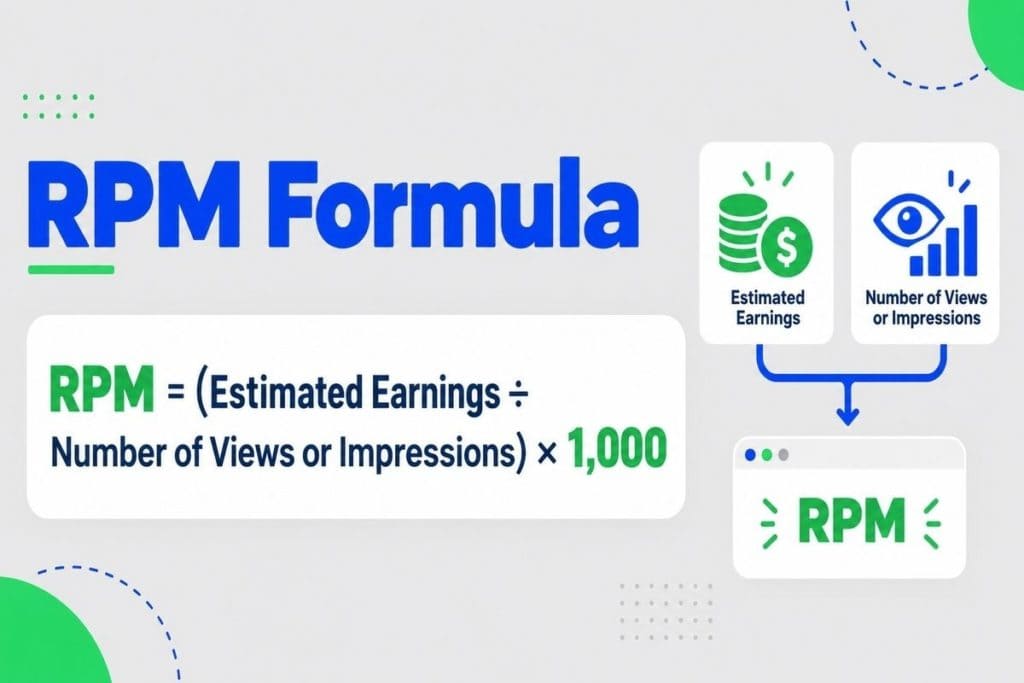
Alt Text: RPM formula infographic showing estimated earnings divided by views or impressions multiplied by one thousand to calculate publisher revenue per thousand
For example, if a publisher earns $200 from 50,000 pageviews:
Page RPM = ($200 ÷ 50,000) × 1,000 = $4
The publisher therefore earns around $4 for every 1,000 pageviews.
That’s why page RPM is especially useful when measuring overall publisher monetization efficiency. If you struggle with low RPM then you need to fix it asap.
CPM vs RPM: Quick Comparison
Here’s a tabular comparison for better clarity:
| Metric | CPM | RPM |
| Full form | Cost Per Mille | Revenue Per Mille |
| Measures | Value/cost per 1,000 ad impressions | Revenue per 1,000 views or impressions |
| Main focus | Ad pricing | Publisher earnings |
| Commonly used by | Advertisers, buyers and publishers | Primarily publishers |
| Useful for | Understanding inventory value | Measuring monetization performance |
| Higher always better? | Not necessarily | Generally positive when sustainable |
Another simple way to remember the difference is:
CPM shows what impressions are worth. RPM shows what the publisher actually turns traffic or inventory into.
Why Can a High CPM Still Produce a Low RPM?
That’s where understanding the CPM vs RPM distinction becomes important for you.
Imagine one ad placement receives a $10 CPM.
That sounds strong.
But if many other ad requests:
- Remain unfilled
- Have poor viewability
- Receive weak demand
In such a situation, the publisher’s overall revenue can still be low. That’s why high traffic doesn’t guarantee high revenue.
Google Ad Manager provides a useful example of this trade-off.
In Google’s example, a fixed $2 CPM floor filled only one opportunity and generated $2.10. Switching to a $2 target CPM filled two opportunities. The resulting eCPM fell about 5%, but total revenue increased from $2.10 to $4, an increase of about 95%.
This is an illustrative example, not a universal benchmark. But it shows an important lesson:
Maximizing CPM alone does not always maximize publisher ad revenue.
Fill rate and overall yield matter too.
Where Does eCPM Fit In?
Another confusing term is eCPM, or effective CPM. It shows the effective revenue generated per 1,000 impressions across different pricing models.
eCPM Formula
Google Ad Manager calculates eCPM using:
Revenue ÷ impressions X 1,000
The easiest way to remember them is:
- CPM = Price → What is the ad being bought/sold for?
- eCPM = Ad performance → What did my ad impressions actually earn?
- RPM = Website monetization → How much money did my traffic generate?
These three are related, but don’t treat them as interchangeable. If your eCPM is low, then you should fix it as it is also important. Don’t neglect anything.
One important thing:
RPM can refer to different units, such as Page RPM or Impression RPM. For publisher discussions, you must always check what the denominator is. If someone says “our RPM is $8,” your next question should be: “Page RPM or impression RPM?”
Which Metric Should Publishers Track?
Don’t choose between CPM and RPM. Instead, track both.
- CPM can help identify whether specific inventory, formats or demand sources are attracting valuable bids.
- RPM shows whether the entire monetization setup is translating traffic into meaningful revenue.
You should evaluate publisher RPM alongside CPM, eCPM, fill rate, viewability, ad requests, and total revenue. A rising CPM with falling fill will be problematic. A slightly lower CPM with stronger fill and higher RPM may produce better overall yield.
Your goal should not be simply to get the highest price per impression. It should be to capture more sustainable value from the inventory you already have.
Summing Up
The difference between CPM vs RPM should be clear by now. If not, then I’ll reiterate that:
- CPM tells you about the value of ad impressions.
- RPM tells you how efficiently your audience and inventory generate revenue.
If you want to have the strongest publisher monetization strategy, then start looking at both metrics together instead of working on either one separately.
Want to Turn Your Ad Metrics Into Better Monetization Decisions?
Auxo Ads helps publishers strengthen demand competition and make smarter monetization decisions across established programmatic ecosystems. Contact us today to unlock more value from your inventory.
Want More Publisher Monetization Insights?
Visit the Auxo Ads Blog and follow Auxo Ads on LinkedIn to stay ahead of what is shaping publisher monetization.
Frequently Asked Questions
- What is the main difference between CPM and RPM?
CPM measures the cost or value of 1,000 ad impressions, while RPM measures how much revenue a publisher earns per 1,000 pageviews or impressions.
- Is eCPM the same as RPM?
Not always. eCPM usually measures earnings per 1,000 ad impressions, while RPM may refer to pageviews, impressions or other units depending on the platform.
- Why can CPM increase while RPM decreases?
A higher CPM does not guarantee higher overall revenue. Lower fill rate, poor viewability, fewer monetized impressions or weaker traffic quality can cause RPM to fall.
- Which is more important for publishers: CPM or RPM?
Publishers should track both. CPM helps evaluate inventory pricing and advertiser demand, while RPM gives a broader picture of how efficiently traffic is generating revenue.
- Can a publisher have a high eCPM but low RPM?
Yes. A publisher may earn well on the ads that actually appear but still have low RPM if fill rate, ad density or monetized impressions are low.







Finally found a place where the bonuses actually make sense. Had a great run last night and the interface is very user-friendly. Check out g7777casino if you want some real action.
Honestly, I’ve tried a few sites recently but this one is surprisingly smooth. The payouts are fair and the games load fast. Definitely my new favorite spot! Check it out at gbo303slot
Super impressed with the interface here. It is very user-friendly and the registration process was a breeze. Highly recommend giving idwakanda123 a shot if you want a hassle-free experience.
Signing up was a breeze. I was able to start playing within minutes without any hassle. Go to spintimephsignup to get started.
I felt lucky the moment I joined. The odds are great and the community is very welcoming. Definitely my new favorite spot pkluckybet7
Simple registration and a very clean layout. I love how straightforward everything is. I always use kudaemas88login for my daily spins.