
Every time you visit a webpage, a real time auction takes place in the background within milliseconds. Wondering what it is? This blog will help you understand that.
The importance of this technology is reflected in its rapid adoption. In fact, the global real-time bidding (RTB) market was valued at USD 14.4 billion in 2023 and is projected to reach $39.6 billion by 2030. It is growing at a CAGR of 15.6%.
As programmatic advertising continues to evolve, understanding the mechanics behind these auctions has become essential for publishers looking to maximize ad revenue.
Today, I’ll break down exactly how a real time auction works behind the scenes, from the moment a user visits a webpage to the instant the winning advertisement is displayed. You’ll also explore the critical roles of:
- Demand Side Platforms (DSPs)
- Supply Side Platforms (SSPs)
- Ad Exchanges
- Header Bidding
- Bid optimization strategies
Quick Summary: A real time auction is the automated process that enables advertisers to bid for an ad impression in milliseconds through Programmatic Advertising. Using technologies like Demand Side Platforms (DSPs), Supply Side Platforms (SSPs), Ad Exchanges, and Header Bidding, publishers maximize ad revenue while advertisers reach the right audience at the right time.
What Is a Real Time Auction in Programmatic Advertising?
A real time auction is the automated process where advertisers compete to purchase an available ad impression instantly when a user visits a webpage or app.
In traditional advertising an inventory is bought weeks or months in advance. However, in Programmatic Advertising, automated software is used to evaluate every available impression individually. The decision is based on multiple signals, including:
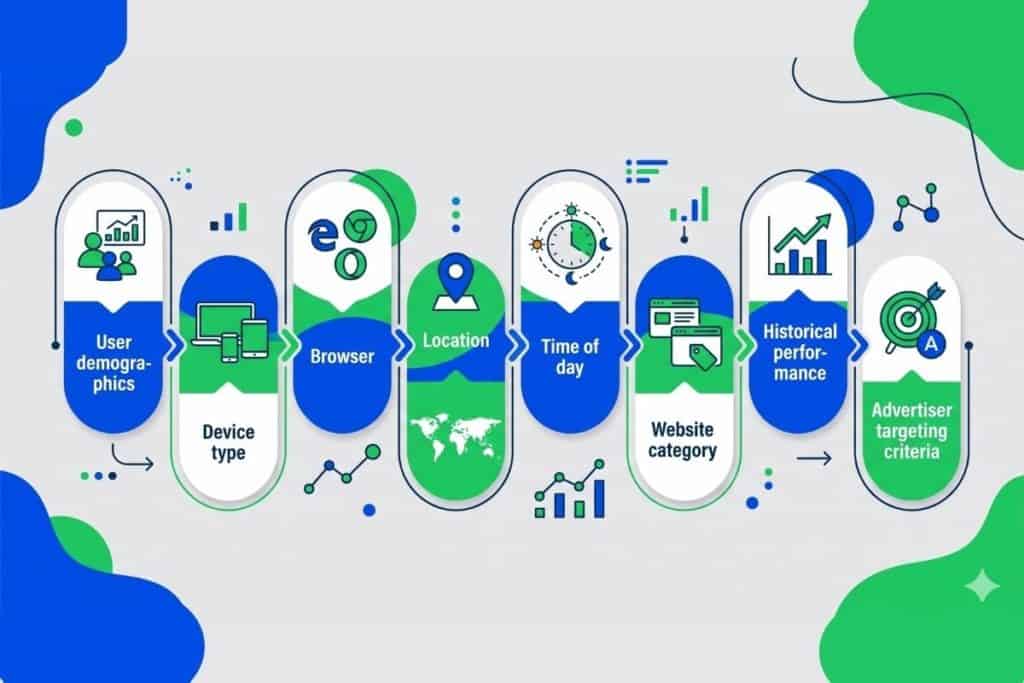
Each impression becomes its own auction, allowing advertisers to bid only on users that match their campaign objectives.
The entire auction takes place at lightning speed. Industry research shows that Google’s ad exchange alone processes more than 100 billion auction requests every day, with each auction typically completing in less than 100 milliseconds.
This is even faster than the average human blink, which takes around 300–400 milliseconds. This level of automation enables billions of advertising decisions to happen seamlessly without affecting page load times.
How a Real-Time Auction Changed Digital Advertising
Before programmatic technology, digital advertising relied heavily on manual negotiations and bulk inventory purchases. Publishers often sold impressions at fixed prices regardless of their actual value.
The introduction of Real-Time Auctions changed everything. In fact, the adoption of Real-Time Bidding (RTB) was remarkably swift. RTB accounted for 92% of all programmatic ad spending as early as 2014. This shows how quickly it became the dominant method for transacting digital advertising.
Real-Time Auctions introduced several major improvements:
- Automated media buying
- Dynamic pricing for every impression
- Better audience targeting
- Increased publisher revenue
- Higher campaign efficiency
- Reduced manual operations
Today, billions of Programmatic Ads are bought and sold every single day using this auction-based ecosystem.
The Key Players Behind Every Real Time Auction
Understanding the auction requires understanding the technology platforms involved.
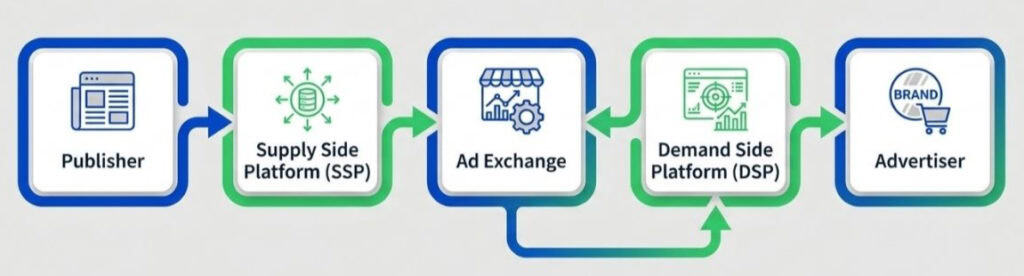
Publisher
The publisher owns the website or mobile app where advertising space is available.
Their goal is simple:
- Maximize revenue
- Fill available inventory
- Maintain a good user experience
Every available advertising slot becomes a potential Ad Inventory for buyers.
Supply Side Platform (SSP) in Real Time Auction
The Supply Side Platform (SSP) represents publishers during the auction.
Its responsibilities include:
- Managing ad inventory
- Packaging impression data
- Creating the Bid Request
- Connecting to multiple Ad Exchanges
- Applying pricing rules
- Selecting the winning bid
Modern SSPs like Auxo Ads also include fraud detection, viewability controls, floor pricing, and yield optimization. The global SSP market is projected to reach $245.95 billion by 2035, growing at a CAGR of 14.13%.
Ad Exchange in Real Time Auction
An Ad Exchange acts as the marketplace where buyers and sellers meet.
Think of it as a stock exchange for advertising impressions.
The exchange receives auction requests from SSPs and distributes them to numerous DSPs simultaneously.
Its primary responsibilities include:
- Running auctions
- Receiving bids
- Comparing bid prices
- Applying auction rules
- Returning the winning advertiser
Without an Ad Exchange, advertisers and publishers would need direct integrations with each other, making the ecosystem highly inefficient. According to Market Intelo, the global Ad Exchange market is expected to increase from $27.4 billion in 2025 to $51.8 billion by 2034.
Demand Side Platform (DSP) in Real Time Auction
The Demand Side Platform (DSP) represents advertisers.
Instead of manually purchasing placements, advertisers upload campaign objectives into the DSP.
When a Bid Request arrives, the DSP instantly evaluates:
- Whether the user matches targeting
- Expected conversion probability
- Budget availability
- Bid strategy
- Historical campaign performance
- Frequency caps
If the impression is valuable, the DSP automatically submits a bid. Fortune Business Insights projects that the global Demand Side Platform market will grow from $48.19 billion in 2026 to $194.43 billion by 2034, representing a robust CAGR of 19%.
Advertiser in Real Time Auction
The advertiser ultimately funds the bid.
Campaign objectives may include:
- Brand awareness
- Lead generation
- Ecommerce sales
- Mobile installs
- Video views
- Customer acquisition
Different advertisers value impressions differently depending on campaign goals.
Step-by-Step: How a Real Time Auction Works
Let’s walk through the complete lifecycle of a real time auction.
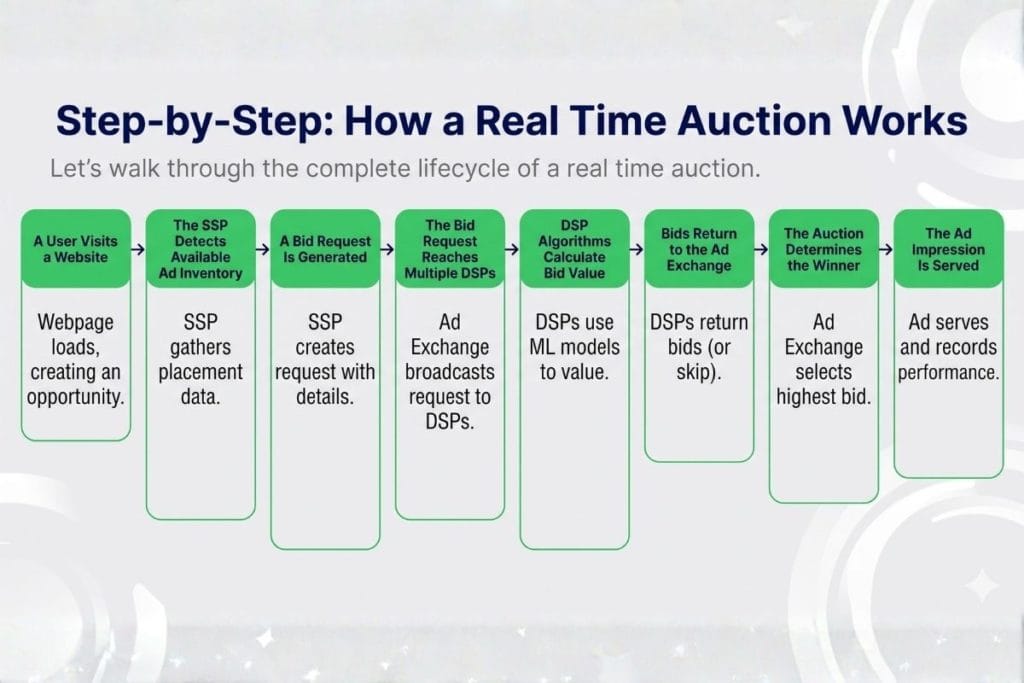
A User Visits a Website
Everything starts when someone lands on a publisher’s webpage. The webpage begins loading its content, including one or more advertising placements. Each placement becomes a new ad opportunity.
The SSP Detects Available Ad Inventory
The publisher’s SSP identifies available Ad Inventory. It collects contextual information such as:
- URL
- Ad size
- Device
- Browser
- User identifiers (where permitted)
- Location
- Page category
This information helps advertisers determine the value of the impression.
A Bid Request Is Generated
The SSP creates a Bid Request. This request contains metadata describing the impression, including:
- Impression ID
- Ad dimensions
- Device information
- Operating system
- Browser
- User segments
- Publisher details
- Floor price
- Supported ad formats
The Bid Request does not include personally identifiable information but provides enough signals for advertisers to evaluate the opportunity.
The Bid Request Reaches Multiple DSPs
The SSP sends the request through one or more Ad Exchanges. Those exchanges broadcast the request to numerous DSPs simultaneously. Each DSP independently decides:
- Should we bid?
- How much should we bid?
- Which creative should we serve?
This process forms the basis of Real-time auction bidding.
DSP Algorithms Calculate Bid Value
The DSP runs machine learning models that predict:
- Click probability
- Conversion likelihood
- Customer lifetime value
- Campaign ROI
- Remaining budget
- Competitive landscape
Instead of assigning one fixed price to every user, the DSP values every impression individually.
For example:
A returning ecommerce shopper may be worth $8 CPM.
A casual visitor may only justify $1 CPM.
Bids Return to the Ad Exchange
Every participating DSP returns:
- Bid amount
- Creative ID
- Campaign details
- Advertiser information
Some DSPs choose not to bid if the impression does not meet campaign requirements.
The Auction Determines the Winner
The Ad Exchange compares all eligible bids.
The winning advertiser is selected based on factors such as:
- Highest bid
- Publisher rules
- Brand safety
- Creative quality
- Deal priority
- Floor price
The winning creative is then returned to the publisher.
The Ad Impression Is Served
Finally, the selected advertisement appears on the webpage. The Ad Impression is recorded. Tracking pixels and measurement systems capture:
- Impression
- Viewability
- Clicks
- Conversions
- Revenue
The user simply sees an advertisement loading almost instantly.
Behind the scenes, dozens of systems have communicated in under 200 milliseconds.
Where Header Bidding Fits into the Process
One of the biggest innovations in publisher monetization is Header Bidding. Traditionally, publishers used a waterfall model where networks competed one after another.
This often reduced competition because higher-priority networks received the first opportunity.
Header Bidding changed that.
Instead of sequential bidding, multiple SSPs receive the same impression simultaneously.
Benefits include:
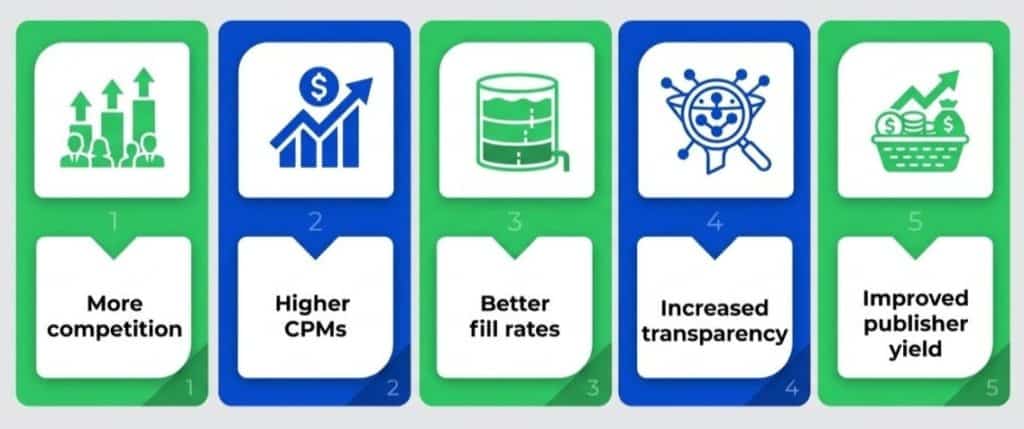
For publishers with premium inventory, Header Bidding has become a core monetization strategy because it enables more buyers to compete for every impression.
What Determines the Winning Bid?
Winning isn’t simply about offering the highest price. Modern auctions evaluate several additional factors.
- Bid Price: The advertiser’s maximum bid remains one of the strongest ranking signals.
- Publisher Floor Price: Publishers often establish minimum acceptable CPMs. Bids below this threshold are rejected automatically.
- Creative Quality: Poor-quality creatives may fail validation checks or violate publisher standards.
- Brand Safety: Publishers use brand safety filters to avoid serving inappropriate advertisements.
- Audience Relevance: Highly relevant advertisements often perform better, benefiting both advertisers and publishers through stronger engagement.
Challenges Behind Real Time Auctions
Although highly efficient, the auction ecosystem faces several ongoing challenges.
- Latency: Every additional partner increases response time. Publishers continuously optimize auction paths to reduce latency.
- Signal Loss: Privacy regulations and browser restrictions have reduced user-level identifiers. This makes targeting more challenging while increasing the importance of contextual signals.
- Ad Fraud: Invalid traffic, bots, and fraudulent impressions continue to impact digital advertising. Modern SSPs, DSPs, and Ad Exchanges employ sophisticated fraud detection technologies to protect buyers and publishers.
- Auction Complexity: Today’s auction ecosystem often includes:
- Multiple SSPs
- Several Ad Exchanges
- Header bidding wrappers
- Identity solutions
- Measurement vendors
- AI-powered optimization engines
Managing these relationships requires continuous optimization.
Best Practices to Maximize Real Time Auction Revenue
Publishers can improve auction performance by focusing on both technology and strategy.
- Optimize Header Bidding Setup: Ensure multiple high-quality demand partners compete simultaneously while minimizing latency.
- Improve Ad Viewability: Higher viewability often attracts stronger bids because advertisers value impressions users are more likely to see.
- Organize Ad Inventory Effectively: Clearly categorized inventory helps buyers understand its value and improves bid quality.
- Monitor Bid Density: A higher number of competitive bids generally leads to stronger auction outcomes.
- Reduce Invalid Traffic: Maintaining high-quality traffic builds advertiser trust and protects long-term revenue.
- Continuously Analyze Auction Data: Regularly review win rates, bid responses, floor prices, and partner performance to identify optimization opportunities.
The Future of Real Time Auctions
Programmatic Advertising continues to evolve rapidly. Several market trends are reshaping auction dynamics:
- AI-driven bid optimization
- Privacy-first identity solutions
- Contextual targeting
- First-party data activation
- Supply path optimization (SPO)
- Curated marketplaces
- Retail media growth
- Sustainability-focused ad delivery
As third-party cookies continue to decline, publishers with strong first-party data strategies and efficient auction infrastructure will be better positioned to maximize revenue.
The future of Real-Time Auctions will be less dependent on individual user tracking and more focused on contextual intelligence, predictive modeling, and transparent supply chains.
Summing Up
Real-Time Auctions are the engine behind modern Programmatic Advertising, enabling advertisers to bid on every ad impression in real time with greater precision and efficiency.
As AI, privacy-first technologies, and advanced bidding strategies continue to evolve, understanding the auction process will be essential for navigating the future of digital advertising and making smarter monetization decisions.
Frequently Asked Questions
- What is a real time auction in programmatic advertising?
A real time auction is an automated bidding process where advertisers compete to buy an ad impression the moment a user visits a webpage or app. The auction takes place within milliseconds through DSPs, SSPs, and Ad Exchanges before the webpage fully loads.
- How does a real time auction work?
When a user visits a webpage, the publisher’s SSP sends a Bid Request to multiple DSPs through an Ad Exchange. Advertisers submit bids based on targeting criteria, and the highest eligible bid wins the auction, allowing the ad to be displayed almost instantly.
- What is the difference between a DSP and an SSP?
A Demand Side Platform (DSP) helps advertisers purchase ad inventory by bidding on impressions, while a Supply Side Platform (SSP) helps publishers sell their available inventory by connecting it with multiple demand sources and maximizing revenue.
- Why is Header Bidding important for publishers?
Header Bidding allows multiple SSPs and advertisers to bid on the same ad impression simultaneously before the ad server makes a decision. This increases competition, improves fill rates, boosts CPMs, and helps publishers generate higher revenue from their ad inventory.
- What factors determine the winner of a real time auction?
The winning bid isn’t based on price alone. Ad Exchanges also consider factors such as publisher floor prices, audience relevance, creative quality, brand safety requirements, and campaign priorities to select the most suitable advertisement for each impression.







Super fast withdrawals and an amazing range of slots. It is honestly the most exciting site I have used. Try jilimacao888 today.
The variety of slots here is insane. I spent hours exploring different themes and the graphics are top-notch. Definitely giving 777jiliwin another go tomorrow.
If you are looking for a place with a huge range of betting options, this is it. Very transparent and easy to navigate. Visit miliarbetlogin.
I really appreciate the customer support here. They helped me fix my login issue in minutes. Five stars for jili123casinologin.
[6652]hhbd Official Login – সেরা অনলাইন ক্যাসিনো ও দ্রুত বিকাশ পেমেন্ট,hhbd অফিসিয়াল লগইন করে সেরা অনলাইন ক্যাসিনো গেম খেলুন। এখানে পাবেন দ্রুত বিকাশ পেমেন্ট এবং স্লট গেম খেলার সহজ নিয়ম। আজই অ্যাপ ডাউনলোড করে শুরু করুন। visit: hhbd
The APK installation was straightforward and the app is way more stable than the browser version. Highly recommend c666gamedownloadapk for a better mobile experience.
I’ve been trying out a few sites lately and this one really stands out. The interface is smooth and the payouts are surprisingly fast. Definitely my new favorite spot to hang out. Check it out at phokadaplay
This site is honestly a hidden gem. Everything from the registration to the actual gaming is seamless. I really enjoy 988wangame.
I’ve been trying a few platforms lately and this one really stands out. The interface is super smooth and the payouts are fast. Definitely recommend checking out caricuan99 if you want a reliable spot.
The bonus offers here are just insane compared to other sites I have tried. Definitely my new go-to place. Give br119bet a try!
The atmosphere here is just great and the game selection is massive. I always feel lucky whenever I play at magojilicasino.
The app version is just fantastic. I can play wherever I go and the graphics are stunning. If you love mobile gaming, 57winapp is the way to go.
Great to see a platform that caters so well to our local needs. The payment methods are convenient and the odds are very competitive. Keep it up. Join tk444bangladesh
Love how easy it is to get into the action here. No complicated steps, just straight to the fun. I always use jilislotphlogin for my daily spins.
I’ve been using this platform for a while now and the interface is super smooth. Fast payouts and a great variety of games. Highly recommend 1xbetphlogin for anyone looking for a reliable site.
Really impressed with the user interface here. Everything is easy to find and the loading times are super fast. Big thanks to canohuto for the great experience